Smallpox Cemetery
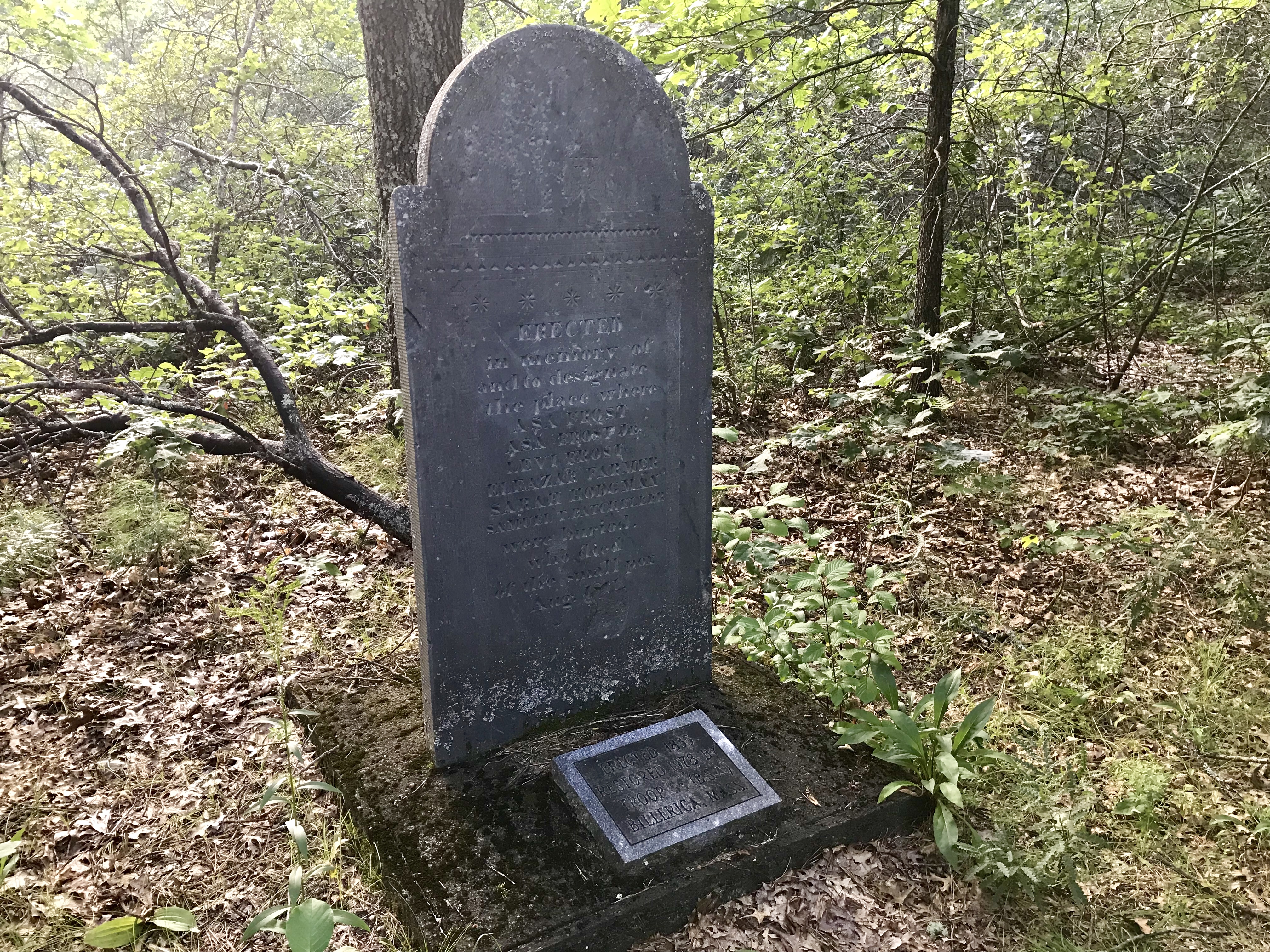
The Smallpox Cemetery, called the Small Pox Cemetery in the town's historic sites lists, is a small burial ground in the woods of North Billerica, south of the railroad from Lowell to Boston, at the bend roughly halfway between the High Street Bridge and the Pond Street Bridge, on private land at 400 High Street near Iron Horse Park. A single tall slate stone marks the place where six people who died in the smallpox outbreak of August 1811 were buried. It is the only burial ground of its kind in Billerica. Earlier victims of the disease, such as John Dutton, his wife Rebeckah and their daughter, and Benjamin Shed Jr., who died of "small pox" in December 1760, were buried with everyone else, in their case in the Old Corner Burying Ground.
John Farmer, writing five years later, gave the only contemporary account of the outbreak: "In the summer of 1811, the small pox made its appearance in the north part of the town. The cause from whence it originated, seems to be involved in mystery. It commenced in the family of Asa Frost, and had communicated to several others, before the disorder was known." The alarm spread "through the town, and to others in the vicinity, till a period was put to it by a general vaccination, which was effected in a few weeks. Of fifteen, who had the small pox, five persons fell victims to its malignity." Asa Frost, born in Chelmsford in 1767, had married Rhoda Trull of Billerica in 1790 and came to Billerica about 1806, near the farm of her father Samuel Trull on Sheldon Street. The town's pest house stood on what a 1930 newspaper called "formerly Johnny Frost Road," now Oak Street.
The stone names six dead. Asa Frost, 44, died with his eldest son, Asa Frost Jr., who had just turned 21, and his brother Levi Frost, 38, who lived with his own family in a house rented from the Middlesex Canal proprietors. Eleazar Farmer, 44, an unmarried Chelmsford man, may have been working for Asa. Sarah Hodgman is the least known; the historian Alec Ingraham thought she was probably the daughter of Abijah Hodgman of Carlisle, who was born about 1796 and died on August 16, 1811, and whose stepmother came from Billerica. The youngest was Samuel T. Batcheller, born on April 24, 1811, the son of Joseph Batcheller and Hannah Batcheller, who was Rhoda Frost's sister; he died on September 6. The Boston Columbian Centinel of August 21, 1811 reported the deaths "in Billerica, of small-pox," of Asa Frost, Levi Frost, Eleazer Farmer and Sarah Hodgman. Farmer counted five deaths, but the stone has six names. None of these deaths was entered in the town's vital records. Rhoda Frost, her other children and the Batchellers lived through the outbreak; Rhoda died in Billerica on September 23, 1849, aged 90.
The town's accounts show how the town dealt with the disease, as the state's smallpox laws of the 1790s required. John Danforth and Josiah Trull, an uncle of two of the victims, were paid for nursing at the "small pox hospital"; John Parker supplied lime and other goods for the "Pest House," and Thomas Richardson rye, cheese and soap. Jacob Farrar was paid for five coffins and for making a "smoak house" at the hospital, and John Dyke for burying Asa Frost Jr. and for "making coffin for a child." John Danforth and Isaac French were paid for digging graves, and Jacob Kittredge for "doctoring at poor and pest houses." Messengers were paid to notify Chelmsford, where Levi Frost's family still had its legal settlement, and on December 16, 1811 the town voted Joseph Batcheller $36 toward "the expense of him and his family's having small pox." The dead were buried together on a small gravel rise in a swamp, said to have been the land of John Trull, far from any house. Tradition, recorded by the physician A. Warren Stearns, says the burials were made at night.
The Boston and Lowell Railroad, chartered in 1830 and opened in 1835, was laid out through the swamp close to the grave. Local tradition, repeated by the Historical Commission in 1986 and by Ingraham, holds that the line was bent into its wide curve between the High Street and Pond Street bridges to spare the burial place. On November 10, 1834, after two earlier requests had been turned down, Town Meeting voted to put up a monument at the smallpox burying ground and named a committee of Capt. Thomas Spaulding, Col. Josiah B. Richardson and Jonathan S. Bowers. In 1835 the town paid $20 to Colonel Richardson for the stone. It is a slab of slate about 92 inches high, 30 inches wide and 3 inches thick, weighing about 800 pounds, and reads: "Erected in memory of and to designate the place where Asa Frost, Asa Frost, Jr., Levi Frost, Eleazar Farmer, Sarah Hodgman, Samuel T. Batcheller were buried, who died of the small pox, Aug., 1811. Erected 1835." Small footstones once marked the graves; one was said to be white, for the child. They have since disappeared.
The grave was largely forgotten until August 1911, when crews leveling the ground for the Boston and Maine Railroad's new car shops found the stone almost hidden by trees and brush. The Lowell Courier-Citizen suggested that the grave might have to be moved, but the railroad decided to leave it alone, and a wire story, "Pest Victims Lie There," carried the find across the country. In May 1912 the Boston Sunday Herald printed a story "handed down by word of mouth" in which Sarah Hodgman, against the pleas of her friends, went alone into the Frost house to nurse the dying when no one else dared, and neighbors later found every person in the house dead. The town's accounts tell a different story, with nurses, supplies and a doctor paid by the town and several of the sick surviving; the Herald also made Levi Frost a son of Asa rather than his brother.
In 1945 the Cemetery Commissioner, Albert Warren Stearns and Harry Dunlap Brown, wrote that because the town had put up the monument at public expense the place "constitutes a public cemetery," though "apparently no care has been taken of this lot," and they began negotiations for its improvement. Their report dated the epidemic 1815 and the monument April 4, 1836, which the stone and the town records do not support. The town's lists of historic sites in 1969 and 1970 included the "Small Pox Cemetery, 1811." In July 1966 some young boys dug into the grave and toppled the stone; police in Billerica and Tewksbury recovered the bones, which were reburied at the site, and the stone was set upright again.
In 1978 Boy Scout Troop 55, which looked after the Middlesex Canal trail from the Talbot Mills to Gray Street, took on the grave as a project. The scouts set the stone on a concrete footing with a concrete apron around it and cleaned off the graffiti, and the Cemetery Department paid about $92 for the materials and a granite plaque at the foot of the stone recording that it was erected in 1835 and restored by the troop in 1978. The restored site was dedicated on October 27, 1979, at which the school physician Dr. Harriet P. Leach spoke on the history of the site and of vaccination, and Cemetery Commissioner Andrew J. Bowen presented certificates of appreciation to the scouts. In January 1986 members of the Historical Commission asked that the Environmental Protection Agency be told of the grave before its meetings with the town on the Iron Horse Park Superfund site. The building of solar farms on High Street and Pond Street and of a new MBTA dispatch center at Iron Horse Park led Alec Ingraham of the Historical Commission to record the cemetery on a state inventory form in July 2019, which rated its condition "Threatened." There is no public right of way to the grave, which stands on a lightly wooded rise about 150 feet south of the tracks; visitors are asked to stay off the tracks and not to trespass on private land.