Point of interest · 1655
The Fordway

The Fordway is a shallow stretch of the Concord River about half a mile above North Billerica village, where Pollard Street now crosses the river. The river bottom here is a ledge that can be seen through the water in a dry summer, and older residents remembered crossing it by stepping from rock to rock. It was the site of the first bridge over the Concord in Billerica, and since 1893 of the Pollard Street bridge, known as the Fordway Bridge.
On May 15, 1657 the General Court affirmed "the importance to the country" of bridges at Billerica and Mistick and provided for their cost to be assessed on the adjoining towns. The bridge was standing by 1659, when William Haile's grant near it mentions "ye great bridge," and the great common field divided that year lay on the east side of the river "below the great bridge." Being rude and primitive, it needed constant repair. In 1660 Ralph Hill Jr. and James Kidder were appointed to join with Chelmsford in repairing "ye bridge Leading to Chelmsford," and in 1662 Billerica sent five hands and Chelmsford four for "a day in the water." When the selectmen of Chelmsford declared their "absolute refusall any longer to assist in maintenance of the great Bridge," Billerica's selectmen ordered "that some of the plankes of that bridge be taken away, that so there may be no passing over it."
On October 9, 1667 the General Court ordered that the bridge "be repayred & vpholden by the tounes of Billerica, Chelmsford, & Groaten," and on December 17 the County Court named John Webb alias Evered, Thomas Hinksman, James Parker and Jonathan Danforth to find "some able and honest artificer." They hired Job Lane, whose contract of January 11, 1667/8 called for arches sixteen feet wide and a floor of oak plank four inches thick, for "seven score and five pounds starling," paid partly in money, wheat, malt, corn and cattle. Lane's bridge was repaired again in 1676 and was carried away by a flood about 1698, "after an existence of forty years." The towns then built a new bridge farther up the river at the Corner (see Corner Bridge), which was nearer the center of Billerica.
In 1789 people of Chelmsford Neck (now part of Lowell) raised a subscription of 59 pounds 10 shillings to build a bridge "at the old place," but on March 3 the selectmen of Billerica "forbid our going on to build on perill of paying all Damnage that should arise therefrom to said Town," and the project was dropped. Maps of 1831 and 1853 show no bridge here, and until 1893 Pollard Street ended on the east side of the river.
The street railway from Lowell to Billerica Center was laid through North Billerica by way of Talbot Avenue and Pollard Street, and it needed a crossing at the Fordway. Town Meeting voted $2,500 in 1892 and $2,000 in 1893, and the street railway paid the rest of the $8,025 cost. The bridge, finished late in 1893, was an iron truss of three spans, each 75 feet long, with a roadway 20 feet wide and no sidewalk. In 1901, the year the street railway rebuilt its half of the bridge, a baker's wagon backed off it through a defective guard rail, and the town settled the claim for $75. A footbridge on the side was voted in August 1910 but was postponed indefinitely in January 1911, after the engineers reported corroded floor beams, rotting stringers under the car track and a truss damaged by a derailed trolley.
After a county hearing on November 13, 1911 and a decree of June 12, 1912, the town, Middlesex County and the Bay State Street Railway agreed to share the cost of a concrete bridge with a double track. On July 29, 1912 the town voted to borrow $9,000. The bridge cost about $25,000: the town and the street railway paid $8,950 each and the county $7,100. It was designed by J. R. Worcester & Co. of Boston, built by the Charles R. Gow Co., and completed in 1912, while a temporary footbridge carried pedestrians, including children on their way to the Talbot School. The selectmen called it "one of the finest in the County of Middlesex." The old iron bridge, about 33 tons, was sold for scrap in 1915 for $6 a ton. The new bridge had six spans of continuous reinforced concrete T-beams with arched soffits, about 239 feet long and 47 feet wide, with the streetcar tracks on its northeast side.
The trolley rails were removed in the 1960s, and the town repaired the bridge in 1958-1959 and again in 1963-1964, when "rotted or exposed reinforcing steel was replaced" and new concrete was gunited. In 1993 the Massachusetts Highway Department called it the best known early example in the state of the continuous multi-span concrete T-beam bridge, and the Massachusetts Historical Commission found it eligible for the National Register. It was nonetheless worn out. The design of a replacement began in 1987, the old bridge was recorded for the Historic American Engineering Record (HAER MA-137) in 1996, and the present bridge, of prestressed concrete box beams, reopened on June 30, 1998 after the crossing had been closed for more than a year. The town's report noted that it "approximates the site of the first bridge in town to span the Concord River." The new bridge kept the name Fordway Bridge.


References
- MACRIS BIL.925
- Hazen, History of Billerica (1883): the first bridge over Concord River at the Fordway, 1657-1660
- Hazen, History of Billerica (1883): repairs of the great bridge with Chelmsford, 1662-1665, and the planks taken away
- Hazen, History of Billerica (1883): the General Court order of 1667 and Job Lane's contract for the bridge
- Hazen, History of Billerica (1883): the bridge carried away by a flood about 1698; the 1789 attempt to rebuild at the Fordway
- Farmer, Historical Memoir of Billerica (1816): the bridge at or near the Fordway before 1658
- Annual Report 1901: the street railway rebuilds its half of the Fordway bridge; damages for a wagon backed off the bridge
- Annual Report 1910-1911: Special Town Meeting of Aug. 2, 1910, foot-bridge across the Fordway Bridge
- Annual Report 1912: county decree and J. R. Worcester & Co. plans for the new Fordway bridge
- Annual Report 1912: Selectmen on the new Fordway bridge and the division of its $25,000 cost
- Annual Report 1912: payments to Chas. R. Gow Co. and J. R. Worcester Co. for the Fordway bridge
- Annual Report 1915: the old iron Fordway bridge sold for scrap
- Annual Report 1964: Fordway bridge repairs, reinforcing steel replaced and concrete gunited
- Annual Report 1998: the Pollard Street (Fordway) bridge reopened June 30, 1998
- Historic American Engineering Record MA-137, Fordway Bridge (1912), photographs and data pages, 1996
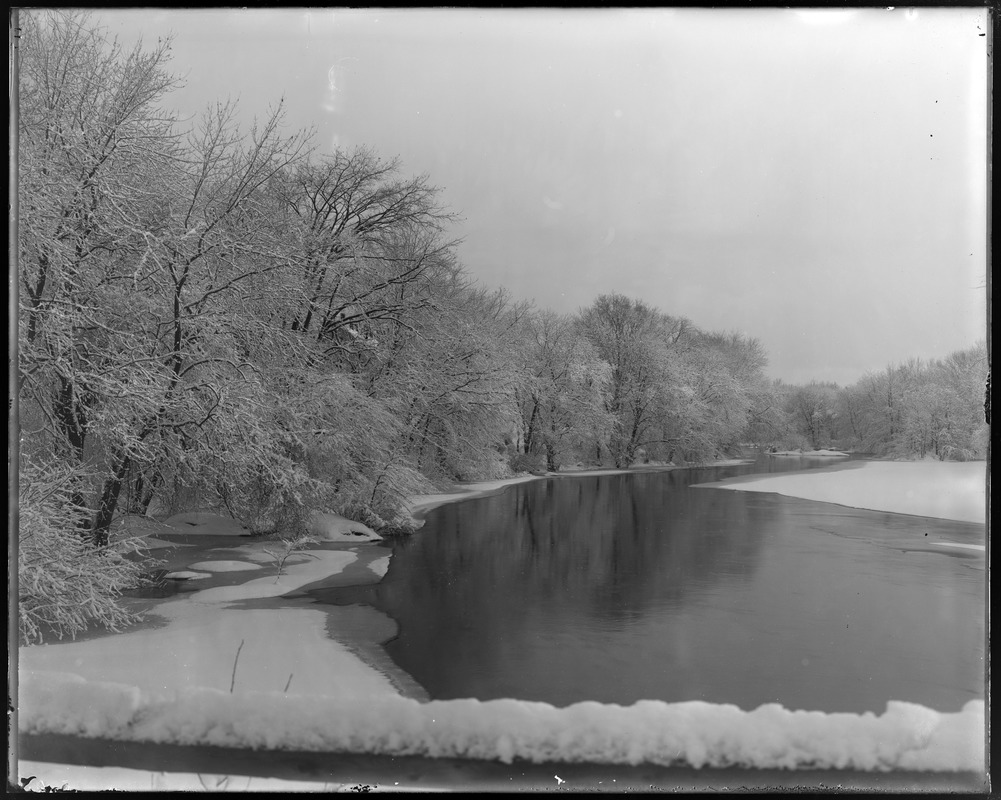
- Billerica Public Library glass negative: Concord River looking north from Fordway bridge after snow storm